
GT3 Racing Rules Explained: BoP, Tech Regs, and Strategy
The mechanics that govern GT3 racing — Balance of Performance, technical regulations, safety car rules, mandatory driver changes, and fuel and tyre strategy explained.
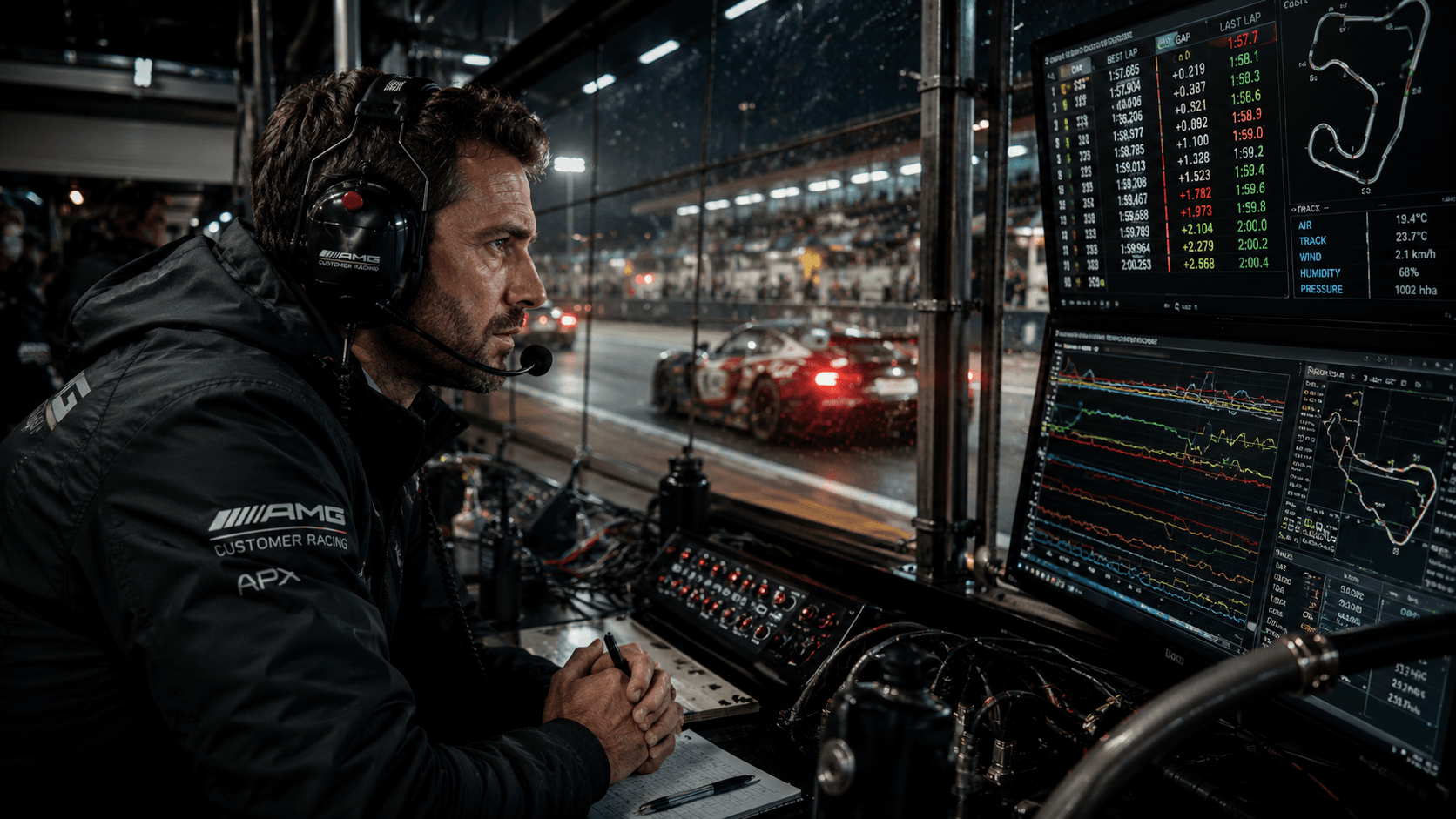
Balance of Performance explained
The Balance of Performance (BoP) is how GT3 keeps more than 20 different cars from different manufacturers competitive with each other. Without it, one manufacturer would dominate as soon as they built the fastest car.
BoP works through a combination of tools: weight ballast (adding kilograms to faster cars), air restrictors (reducing engine intake to cut power), ride height adjustments, and fuel tank capacity limits. Every car in the field has its own BoP specification, updated regularly throughout the season.
SRO maintains a dedicated BoP team that analyses telemetry from every race, runs controlled back-to-back tests at circuits, and issues updates before each event. Manufacturers can appeal BoP decisions and submit data to support changes.
The system is not perfect. Teams invest heavily in understanding which BoP setup suits which circuit, and small adjustments can swing a car from front-runner to midfield overnight.
Technical regulations
GT3 cars must start from a homologated production road car. The rules define maximum modifications allowed, effectively setting what can and cannot be changed from the road car base.
Key technical requirements include:
- ◆Safety cage: a full FIA-approved roll cage welded into the body
- ◆ABS and traction control: mandatory on all GT3 cars, unlike many other racing classes
- ◆Sequential gearbox: paddle-shift transmission replacing the road car unit
- ◆Racing brakes: larger, vented steel discs with racing calipers (carbon ceramic brakes are generally banned to keep costs down)
- ◆Slick tyres: supplied by a single control tyre manufacturer per championship (Pirelli in most SRO series)
- ◆Fixed engine: the engine must be based on the road car unit, preventing full custom race engines
The combination of required ABS and TC, combined with a relatively accessible setup philosophy, is part of why GT3 is accessible to amateur drivers.
Safety car rules
GT3 races use both Full Course Yellow (FCY) periods and full Safety Car deployments, depending on the championship and the severity of the incident.
During a Full Course Yellow, all drivers must reduce speed to a defined delta time and no overtaking is permitted. Pit lane remains open, making FCY periods critical strategic moments. A team that pits under FCY avoids losing track position to cars that do not.
Under a Safety Car, the field bunches up behind the SC and maintains a slow pace until the incident is cleared. When racing resumes, the SC returns to the pits and the leader controls the restart pace.
In endurance races, Safety Car timing is one of the biggest strategic variables. A well-timed stop under the SC can gain a team dozens of positions and potentially decide the race.
Driver changes
In sprint racing (typically 60 to 90 minutes), there are usually no mandatory driver changes. One driver completes the race, with a single pitstop for tyres and fuel.
In endurance racing, mandatory driver changes are central to the format. In a 3-hour race, each driver typically completes one or two stints. In a 24-hour race, a three-driver crew will each complete multiple stints across the night and day.
The FIA driver grading system (Bronze, Silver, Gold, Platinum) determines minimum driving time requirements for each grade. A Platinum driver cannot simply sit in the car for most of a 24-hour race; regulations ensure the amateur drivers get meaningful track time. This protects the Pro-Am format that funds team operations.
Driver changes must be completed with the car stationary in the pit box. In most series the minimum stationary time is set by mandatory pitstop rules, ensuring no team gains an advantage through ultra-fast changes.
Fuel and tyres
Fuel strategy is a defining element of GT3 endurance racing. Cars have a fixed maximum fuel tank capacity set by BoP, and fuel consumption varies by manufacturer, circuit, and driving style.
Teams carry detailed fuel maps into every race, calculating the minimum number of stops required to finish. Running longer on a tank ("stretching" a stint) can save a stop, but risks running out of fuel or being forced to use fuel-saving modes that cost lap time.
Tyre management is equally complex. In endurance races drivers must manage tyre degradation over long stints, especially on abrasive circuits like Spa or Paul Ricard. Push too hard early and the tyres "go off," costing several seconds per lap by the end of a stint.
In most SRO championships, Pirelli supplies a single control tyre compound per event. Teams have no tyre choice; everyone runs the same rubber, which keeps costs down and focuses competition on strategy and driving rather than tyre development.
Want to see how these rules play out across an actual weekend? See GT3 Race Weekend Explained and How Qualifying Works.
// Ready to explore?